Garda Awarded Blue Flag for Environmental Excellence and Water Quality
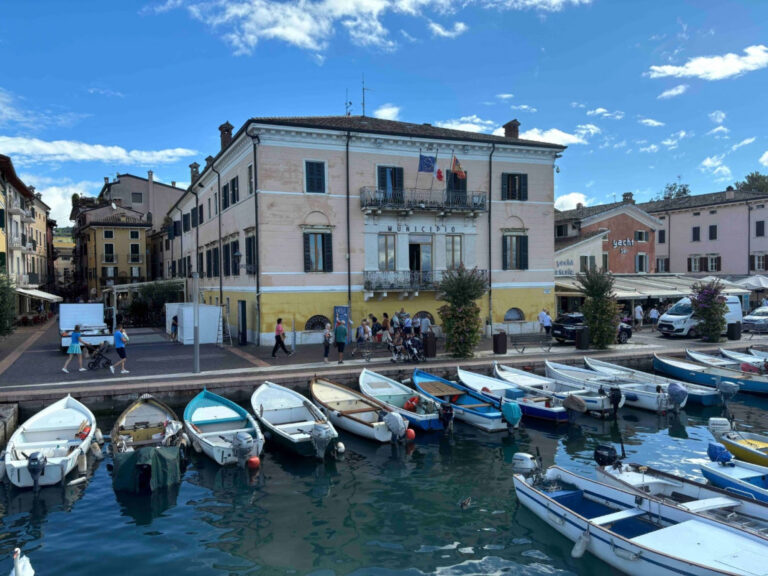
A blue flag branded Europe for Garda. It was officially awarded yesterday morning to Mayor Maurizio Ferrari in the beautiful setting of Piazza Castello by the president of Fee Italiani, Roberto Riccioni.
The peninsula so beloved by poet Catullus has earned this distinction, making Sirmione the only city in Lombardy and the only lake area in Italy to do so, thanks to its commitment to environmental matters. Indeed, the inclusion of Sirmione and thus Garda in the areas of excellence is not solely due to the protection of bathing water quality but also reflects a broader commitment to environmental and service improvements.
Environmental Interventions and Initiatives
Initiatives range from switching to electric motors in the historic center to improving water quality for bathing, implementing waste separation, restricting access to beaches by cars, increasing surveillance, connecting sewage systems to a centralized treatment plant, to the project of creating a fishing museum that the Municipality plans to establish in the Lugana area using two state-owned buildings. With the blue flag, the mayor also received a list of commitments that Sirmione undertakes as a formal pledge, covering the aspects mentioned above.
The first step, probably by the end of June, will be the complete ban on mopeds powered by internal combustion engines in the historic center. Garda blue, like the “flag” awarded yesterday morning to the city of Sirmione by the European Foundation officials who grant these prestigious environmental awards.
Water Quality and Restrictions
The largest Italian lake continues to improve its water quality rankings, although yesterday, coinciding with the start of summer, the first bathing bans were issued. These bans apply to only three beaches, all located in Desenzano, out of 125 monitored beaches: 52 in the Brescia area, with the remaining in the Verona and Trentino areas.
Overall, the situation appears decidedly good. Never in the past 30 years had the bathing season opened with all beaches open for swimming. The favorable conditions have persisted along the entire perimeter of the lake until June 20.
Thus, Garda begins to reap the benefits of interventions and projects undertaken over the past quarter-century, which have led to the realization of a large-scale collection and treatment system. These include 120 kilometers of pipelines encircling Garda, pumping stations, remote control systems, and a centralized treatment plant in Peschiera, with investments now around 200 billion lire.
The completion of sewage treatment for the upper Garda area remains pending, particularly in Limone, where years ago, funds were available to build a local treatment plant in one of the disused tunnels operated by Anas. However, this project is now considered nearly impossible due to the difficulty in obtaining the necessary permits.
Meanwhile, works are nearing completion in the projects started by Garda Uno, involving large parts of the lakeside municipalities. These works include expansion, renovation, and completion of sewage networks.
The total investment amounts to approximately 8 billion lire, with 5 billion already allocated for the Limone plant. Garda has also promoted the “transparency” campaign via the “summerservice” system, created in collaboration with Adac, the powerful German automobile club with 14 million members.
Thanks to the work of a biologist employed by the Lake Constance Hydrobiology Institute, water analysis results are collected and processed. These are then published daily across German-speaking countries via media: newspapers, radio, television, the internet, and toll-free phone numbers.
Those on the lake can access information through the environmental secretariat of Comunità del Garda (Tel. 0365290411) or on the website www.lagodigarda.it.
Future Problems and Challenges
The largest Italian lake still faces issues related to shoreline modifications. The main danger is the rapid urbanization of the shores—especially in certain areas of the lower lake but also elsewhere—progressing at an alarming rate, as demonstrated by active cranes and recent “scandals”.