Ancient Roman Mosaics Discovered Near Toscolano Maderno Villa
In Toscolano Maderno, in the area of the Roman villa, between the parish church and the paper mill, new mosaics have been discovered on land owned by the Istituto di sostentamento del clero, surpassing in beauty those unearthed in 1967. These are stylized floral designs and geometric symbols in polychrome colors.
“They are believed to date from the fourth or fifth century,” states archaeologist Angelo Ghiroldi, who carried out the excavations. “They belong to the dining or reception room, the so-called tricora. In the center, there’s the sign of three small apses. Ghiroldi uncovered a square approximately two meters by two, but the mosaic surface is estimated to be around twenty square meters.”
Details of the discovery and the interests of the Superintendence
Elisabetta Rofiìa, a zone inspector for the Soprintendenza ai Beni archeologici della Regione, explains: “Given its richness and vastness, the villa can rival those in Sirmione and Desenzano. The findings confirm the hypotheses previously made. Now, we need to have the courage to enhance it, making the area accessible to the public.”
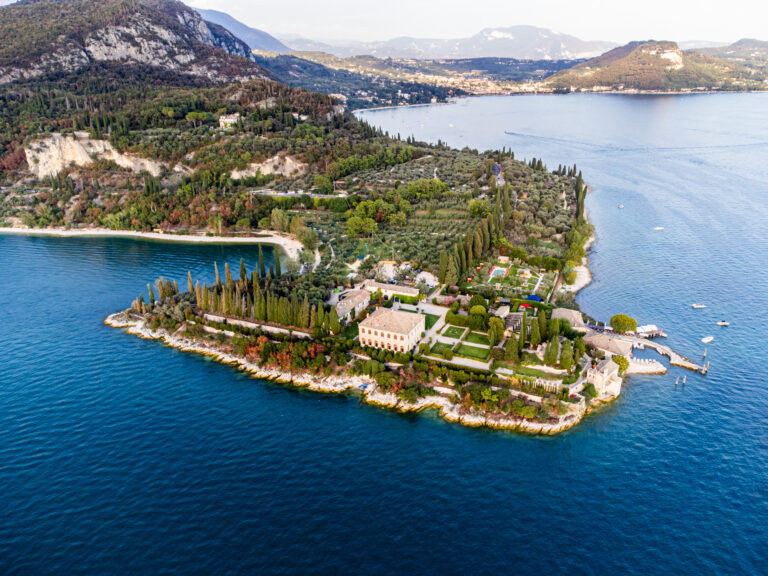
The Roman villa was probably built in 38 BC by the consul Publio Nonio Asprenate, on land gifted to him by Augusto, in recognition of his services defending the Rhine against the Germans. Spacious and rich with terraces, gardens, aqueducts, and fountains (fed by the Pulciano spring), it included sports fields, temples dedicated to Jupiter and Bacchus, and even a harbor on the lake, occupying much of the promontory up to the Bersaglio.
Dividing the square in half and roughly following the 45 bis road, it extended up to the current Morani oil mill, with a frontage of about five hundred linear meters. The 1967 excavations revealed floors covered with fine mosaics. The Superintendence of Fine Arts intervened, discovering the remains of other rooms and coins. To protect these from bad weather and vandalism—material had been stolen—a provisional plexiglass cover was installed.
In 1997, architect Lodovico Reguitti, then a municipal technician, studied a consolidation and restoration project at a cost of 972 million lire. It involved a hybrid solution combining the Desenzano-style tethers with the laminated ones on iron slabs. The foundations were reinforced with micropiles. The transparent tethers were designed to prevent condensation buildup.
The Fondo Investimenti della Lombardia (Frisl) accepted the funding request but, later, the new municipal administrators decided to abstain, preferring other more urgent projects.
New discovery and protection operations
Currently, the new discovery was accidental, like that 33 years ago, and not linked to a planned excavation campaign. The Istituto di sostentamento del clero built, just four or five meters away, a house intended as accommodation for elderly priests (six apartments). For this operation, connections to the water, gas, and electricity networks were required.
Before laying the nets, the archaeologist conducted surveys. The area is under protection, and the Soprintendenza mandates proceeding cautiously. “In recent years,” adds Ghiroldi, “we surveyed about 1200 square meters, finding only foundation walls. Nothing special. Now, however, we have a pleasant surprise.”
The deputy mayor Vincenzo Chimini, head of Public Works, explains: “We will cover the area with sand and expandable material, laying a thin layer of cement.”
“In the coming days, we will meet with the officials of the Soprintendenza to review the situation and decide on the intervention plan,” says Mayor Paolo Elena. “Recently, we declined a one billion lire fund from Frisi, which we would have had to return. I hope that, under the law concerning the Obiettivo 2 regions—covering depressed areas and the entire territory of the Comunità Montana—it will be possible to obtain non-repayable grants.”
The most urgent priority now is to relocate the activities of Franz Dominici, who occupies part of the site with his bulk material storage. We will move him to the hill of San Giorgio, near the golf course, bordering Bogliaco.