Lake Garda and Adige River: Challenges in Water Management and Flood Prevention
Lake Garda and Adige: two fronts in the emergency caused by bad weather. The issue regarding the lake is delicate and at the same time difficult to resolve. To better understand the situation, a brief look into recent history is necessary: “Until not many years ago, during this period, there was a rapid drainage of Garda, increasing the flow of the Mincio,” explains Alessandro Muraca, professor of hydraulic constructions at the University of Brescia and consultant for municipal administrations and the Veneto Region. “By keeping the Salionze dam open, the Garda level would drop to about 70-90 centimeters above the hydrographic zero. This allowed, in case of heavy rain, the reception of waters coming from the Galleria Mori-Torbole.”
It involves a substantial gallery capable of discharging up to 500 cubic meters per second. An enormous amount of water, which flows at the border between the veronese and trentine shores. However, the winter “draining” operation of Garda sometimes had a negative consequence: “If the following months experienced a period of drought,” adds Muraca, “Garda would not fill sufficiently, at least to the levels desired by residents.”
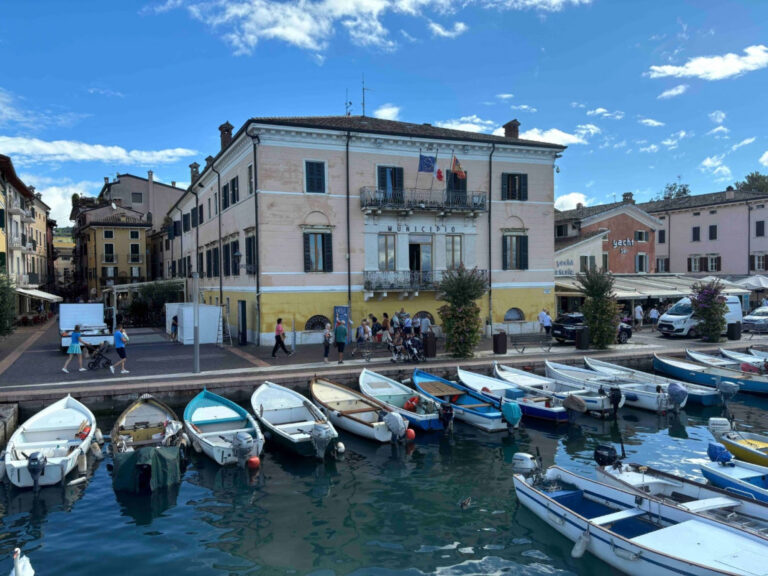
This meant that the season could start with the lake “low.” What could happen? The first effect was visual: tourists would find a low and less “inviting” lake. But there was more. “In certain points, the level in the harbors was so low that boats could not dock without risking to run aground. Another problem was related to agriculture. With little water in the lake, it was impossible to guarantee a flow sufficient to meet the needs of agriculture, especially in Mantovano and Veronese. During the peak season, in fact, as much as 60 cubic meters per second were drawn at Salionze.”
Various needs, therefore, could be compromised by the winter lowering. Moreover, over the years, the use of the Galleria Mori-Torbole was reduced due to the negative effects it could create. “The water of the Adige is, in fact, much colder than that of the Lake, but also more polluted and has a considerable solid transport that, when deposited in the Lake, forms a muddy zone right in front of the towns on the shoreline,” explains Muraca.
In recent years, a different solution has been adopted: keep the level higher during winter, risking some flood danger, but ensuring a “full” Garda during the summer. The maximum level is reached in late spring, generally in May, when the water rises to 1.40 meters. “We are thus faced with a compromise. Risk something in winter to have a quiet summer, or vice versa. The solution might come from rationalizing resources for irrigation purposes. If withdrawals in summer are reduced, winter outflows could also be increased.”
Water emergency and management
The second aspect of the water emergency concerns the Adige more directly. “The problem is common to many others. Rivers, and generally all watercourses, tend to fill more due to extensive urbanization,” explains Muraca. “Nowadays, greenery is sparse in cities. Every time construction happens, with the same amount of precipitation, the surface runoff increases. Water no longer penetrates the ground and ends up in sewers or drainage ditches, which often are unable to handle such quantities. The cycle ultimately concludes in final outlets: rivers, ditches, and channels that end up overflowing.”
But is there a solution, or are we destined to face more or less significant floods each time these rains occur? “The solution exists and is already practiced in some European countries. It is enough to require builders to facilitate water drainage. There are permeable pavements designed for this purpose that allow for drainage; or to create reservoirs that promote subterranean drainage or collect water in containers which, once the emergency is over, will release it into the underground. All these measures have a cost, borne by the builders, but it is still less than what the community pays in case of floods.”