Garda Choir Continues Tradition of Biganàte with Christmas Singing Tour
They started on Monday evening and finished only on January 6: it is the long «tour de force» of the singers from La Rocca choir, engaged in the traditional «biganàte», the greeting songs brought door-to-door. As every year, the choir members directed by Giorgio Avanzini will be very active every evening during the Christmas period: some families book their turn well in advance.
The singing marathon and the traditions of the biganàte
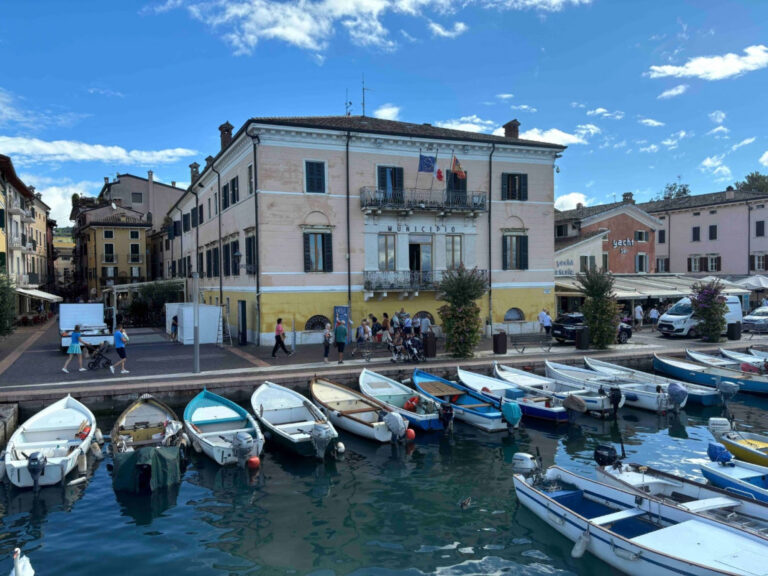
This time, the singing marathon began at the lakeside market, under the pavilion of the gastronomic stand of «Natale tra gli olivi» (Christmas among the Olive Trees), says Beppe Bertamè, the indefatigable president of the Gardesana choir. «The stand was run by the hotel association, which asked us to do some Christmas singing. For us, it marked the start of our “biganàte”, which will continue until Epiphany».
And it will be right around the Epiphany bonfire, set up in Piazza on January 6, that this latest effort of the singers will come to an end. In the meantime, not satisfied with singing every evening, they will also perform a concert on Christmas Day: December 25, at 5 p.m., they will perform in front of the large Nativity scene in the Rimembranza park.
The tradition and repertoire of Garda Christmas choirs
Since the year of its founding, 1956, the La Rocca choir has kept alive in Garda the ancient tradition of the «biganàte». The repertoire of Christmas songs collected over the years is truly remarkable. Perhaps the most beautiful among Garda Christmas carols is the one of the «Tre Re» (Three Kings): «We are three Kings come from the East to worship Jesus, who is a King of the higher ones among all magi that ever existed in the world».
At each stop, there is a «vegnì dentre a béver en gòto»: it takes great stamina to endure. Usually, the choir departs as a group and then, night after night, the lines thin out. In the past, when the pockets of Garda residents contained very little money, the most sought-after «biganàte» were those performed outside the houses of the wealthy.
They would go there bundled up in overcoats, carrying the star and singing loudly, then waiting for someone to signal that it was okay to enter and share a drink. As recounts Pino Crescini in his book «Parole che muoiono» (Words that Die), recently presented, «their leader would lean the staff with the five-pointed star against the wall and enter majestically with his companions». However, not all doors would open.
At times, they would shout «O che z ê nt ostinata, che gn ê nt no i ne porta: fénghela su la porta e scapém via!» (Oh, it’s stubborn, it’s not bringing us in: close the door and let’s go!), as a way to retaliate against the insult they faced. Crescini also states that the term «biganàta» derives from the German Weihnacht, meaning Christmas, holy night. In essence, it is the Christmas gift.
Marangoni, who writes about Caprino, where the term is not «biganàta» but «gabinàta», hypothesizes a connection between gabe — gift — and nacht — night: «the night of the divine gift, the birth of the Savior». It is probably instead the pagan night of the sun god: according to many historians, Christian Christmas would have been superimposed on these ancient rituals.
The point of convergence between the ancient solar worship and Christian Christmas remains today the «biganàte», kept alive in Garda by the La Rocca choir.