
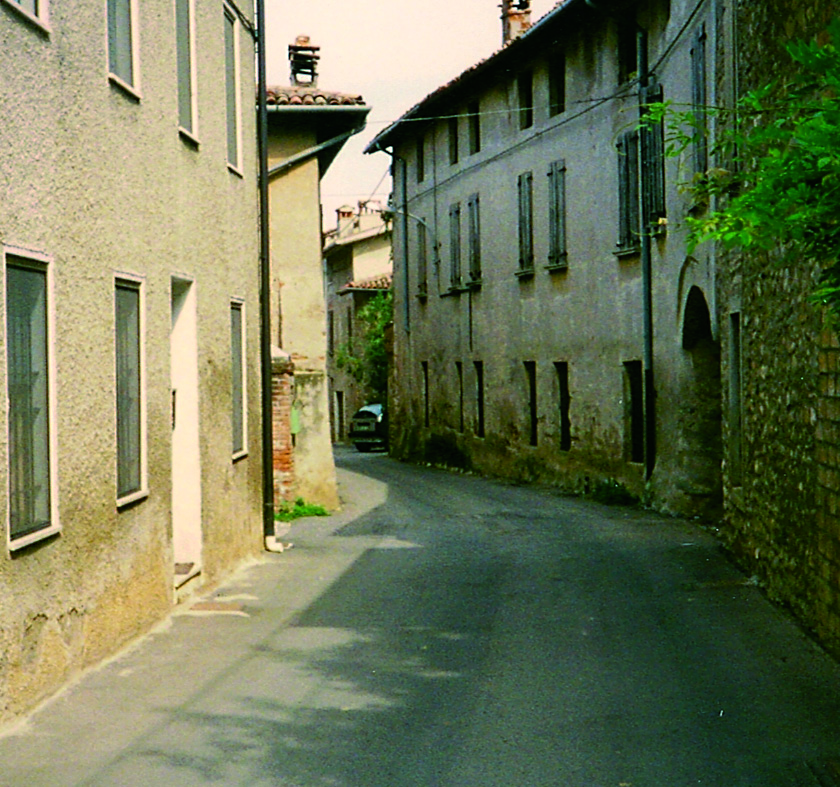
Cantrina: Where Stone Walls Whisper Ancient Stories
A hilltop hamlet where time slows down and memories of a resilient past linger in the air.
Location: Cantrina (Bedizzole) | Era: 1950s – Present | Reading Time: 4 Minutes
The Lead: Just two kilometers from the main town, the hamlet of Cantrina sits atop the highest hill, revealing itself past the “Roccolo” curve. It is a place suspended in time, offering an amphitheater view of Serle, Gaver, and the snow-capped peak of Monte Baldo. Here, the winding road hugs irregular stone houses and vegetable gardens, leading to a small square that holds the heart of the community: a gentle 18th-century church dedicated to Mary.
🗝️ Key Facts
- here: Cantrina (Bedizzole (Bs))
- Era: Mid-20th Century to Present
- Visitability: Public Village / Church open for services
- Key Feature: 18th-Century Marian Church & Historic Rural Architecture
The Soul of the Village
Life in Cantrina moves at its own pace. Mass is celebrated in the small church once a month, creating a festive atmosphere often filled with children. Outside, patient dogs wait in the square, occasionally scratching at the heavy wooden doors hoping to join their owners inside.
Recently, restoration works moved the liturgy to the sacristy. In this intimate setting, children—usually restless—stand mesmerized by the flickering candlelight on the makeshift altar, watching with curiosity under the affectionate gaze of the priest. The community notice board outside often bears quirky, heartwarming appeals, such as a handwritten note reading: “If anyone finds a parakeet, please let me know.”
Cantrina is ancient, beautiful, and characteristic. However, to truly understand its essence, one must listen to the voices that guard its history. Three elderly women, eyes sparkling with the vitality of their youth, gathered around a table on a rainy day to share memories of a world that no longer exists—a world from seventy years ago.
A Life by the Seasons
In the mid-20th century, life in the farmhouses was dictated by the rhythm of the earth. Poverty was widespread; clothes were tattered, and children often went barefoot. The calendar was not marked by dates, but by harvest: silkworms in May, cocoons and wheat in June, corn in September, and the grape harvest in October.
The silkworm season was particularly demanding. At 4:00 AM, children lined up to collect mulberry branches. The worms were kept everywhere—initially in the kitchen, where families ate hunched under the racks. The women recall with a laugh how silkworm waste would sometimes fall directly into their soup plates. Later, the worms were moved to the bedrooms, where the waste would fall from the ceiling beams onto the beds. With no insecticides, fleas were a constant companion.
Hunger and Hardship
Food was scarce and simple. Lunch often consisted of polenta with two eggs divided among four people, or roasted chicory with lard. While milk was available, bread was a luxury discovered much later.
Raising poultry was an exhausting task. Children would carry broody hens and chicks in small crates to the fields between Cantrina and Mocasina, walking up to fifteen kilometers a day. The fields were rich in insects and herbs, providing free nourishment for the birds. The chicks were fed “risetta” (rice waste), and if a chicken fell ill, it was quickly slaughtered and eaten so as not to waste the meat. However, the best parts—the thighs—went to the field workers, while the children received the neck and a foot.
The Joy of the Harvest
Despite the hardships, the Vendemmia (grape harvest) was awaited with joy because it meant good food. Everyone helped, with children tasked to pick up fallen grapes from the ground.
The landowners and neighbors provided hearty meals to the workers. “Ciso” offered cotechino with polenta and salted bleak (a local fish). The “Lombardi of Masciaga” family brought baskets of polenta and cooked salami. The “Zizioli” family provided polenta with a horse meat salami for everyone. The deliciousness of those salamis remains a vivid memory, a stark contrast to the daily hunger.
Resilience and Simple Games
School was attended only in winter. On Sundays, girls gathered grass all day to finish their chores before visiting the nuns. The sisters would give them a few cents for a lemon or some licorice. Water was scarce—the aqueduct wasn’t built until 1953—and even at the convent, a single ladle of water had to be shared among five girls.
First Communion was a major event at age six. It was the only time everyone had a proper dress, along with a holy card and a medal. Afterward, the children would join the “Quarantore” procession, receiving a small bundle containing two marbles, two peanuts, and a carob pod wrapped in a handkerchief.
Playtime required imagination. Peach pits were used for games, flicked out of small holes with a flat stone. Rag dolls had hair made from corn silk. Boys built toy guns from wood, string, and clothespins. At night, they slept on pajù di scarfoi—mattresses stuffed with corn husks.
Social life took place in the stables during winter or on the stone walls outside during summer. If the men had a liter of wine, they shared it. As the women of Cantrina recall: “We were in rags, and we were hungry, but we were happy, and we loved each other.”

