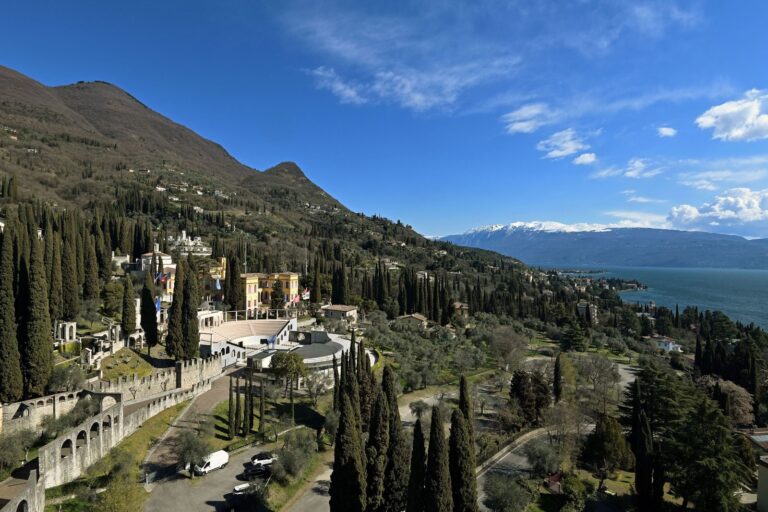
Garda’s ‘Àndre’ Wind: Its Origins and Threats to the Lake
There is a word that these days is passing from mouth to mouth among the people of Garda, who, worried, watch the lake’s levels from the port square: àndre. It is heard barely whispered, as if to exorcise it: l’àndre is frightening. The àndre is a wind, one of the most insidious of Garda. A “tensed wind,” as Pino Crescini defined it in the «Vocabolario dei pescatori di Garda». A wind that blows violently for five or six hours straight, then subsides only to return for two or three days in a row. And it arrives in winter.
Origin and characteristics of the àndre
The àndre is one of those winds that occasionally make Lake Garda truly «marino» (marine). «Fluctibus et fremitu adsurgens Benace marino». «Benaco, swelling with waves and sea-like fury»: that is how Virgil, the Mantuan poet who knew the lake well, described Garda in famous verse. The similarity to Virgil’s Georgics also inspired Goethe when he was along Garda’s shores during his «Journey in Italy».
After the Latin quotation from Virgil, Goethe wrote: «It is the first Latin verse whose content remains vivid before me and which, at this very moment, as the wind blows stronger pushing the waves higher, toward the shore, is as true as it was eighteen centuries ago.»
Poetic or not, however, if the àndre rises now that the lake is so high, serious trouble is ahead. During the famous flood of 1960, the greatest damage was caused precisely by this wind, which pushed the water into squares and streets for hours, flooding houses and public buildings. The possibility of that event repeating itself is not so remote: that’s why the name of the wind is whispered barely at Garda’s shores.
Origin of the name ‘àndre’
Where does this strange name for the wind come from? According to Malfer, andré derives from “to go”. For Crescini, however, it is «etymologically unknown», unless it is hypothesized to be related to the local Trentino Brescian verb «vànder», or to the Bergamasque «andì» or the Friulian «vàndi», which in turn come from Latin «vanare», meaning «to ventilate, to stir, to beat».
«It could also come», hypothesizes Crescini, «from the Veronese vandàr», which means «to carry here and there» and itself derives from the Vulgar Latin «vannitare», meaning «to aerate the fodder». But these are academic discussions that today are secondary. Today, with the high water level, the àndre instills fear, and its name is barely whispered, almost to avoid evoking its presence. (a.p.)