The San Martino della Battaglia Monumental Complex, situated in a historic hamlet of Desenzano del Garda, stands as the cardinal memorial of the Italian Risorgimento and the national unification process. Erected on the very morainic hills that witnessed the bloody clashes of 24 June 1859, this solemn site combines historical remembrance with the preservation of fallen soldiers’ remains, drawing scholars, international delegations, and visitors exploring the rich heritage of the Lake Garda region.
The 1859 Battle and the Birth of the Red Cross
The Battle of San Martino and Solferino, fought during the Second War of Independence, pitted the Franco-Piedmontese army against the Imperial Austrian forces. While the French faced Emperor Franz Joseph’s divisions at Solferino, the Sardinian-Piedmontese army, commanded by King Victor Emmanuel II, engaged in brutal frontal assaults against the Austrian VIII Army Corps on the hills of San Martino. The relentless bayonet charges amidst the vineyards lasted for over twelve hours under a fierce summer thunderstorm.
The staggering human toll—over 40,000 dead, wounded, and missing across the front—profoundly shocked Swiss citizen Henry Dunant. Witnessing the severe lack of organized medical care, Dunant was inspired to write A Memory of Solferino, laying the foundational concepts that directly led to the creation of the International Red Cross and the first Geneva Convention in 1864.
The 64-Metre Monumental Tower
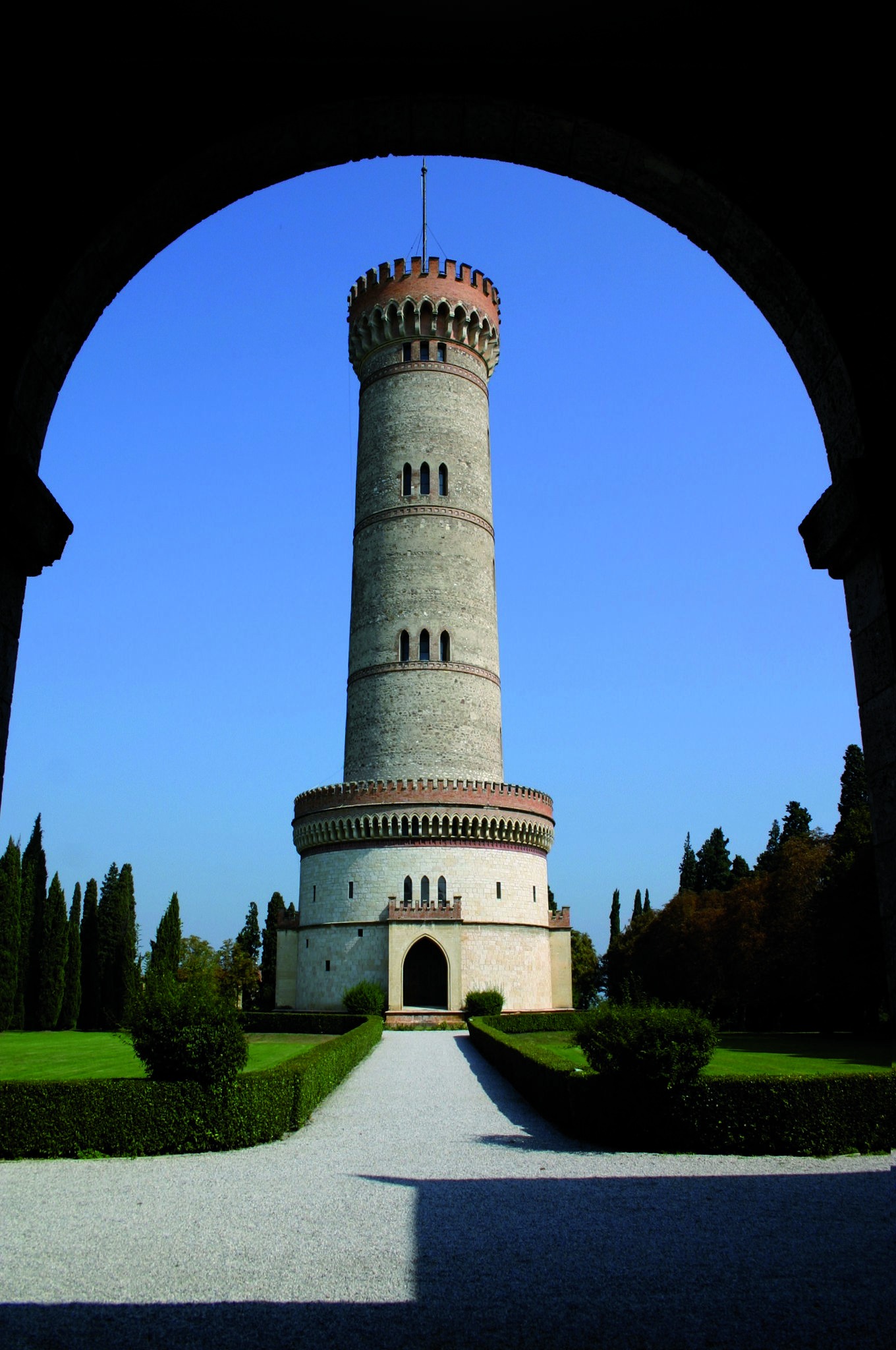
The site is dominated by the majestic Monumental Tower, constructed between 1880 and 1893 to a design by Giacomo Frizzoni. Inaugurated in the presence of King Umberto I, this 64-metre circular structure of grey Mazzano stone and brick proudly overlooks the lower Lake Garda basin.
Visitors ascend to the viewing terrace via a gentle internal helical ramp. The walls of this ramp are entirely adorned with magnificent frescoes by prominent artists of the era, illustrating the fundamental milestones of the Risorgimento epic from 1848 to the capture of Rome in 1870. The upper panoramic terrace offers a breathtaking 360-degree view, stretching from the nearby Sirmione peninsula—home to the Scaliger Castle and Catullus’ Grottoes—to the peaks of Monte Baldo and the distant Apennines.
The Ossuary and the Risorgimento Museum
A short distance through the tree-lined park lies the Ossuary, consecrated in 1870. The apse chapel respectfully houses the skeletal remains of 2,619 fallen soldiers—1,273 Italians and 1,346 Austrians—united in a single sepulchre as a profound testament to reconciliation and the universal respect owed to all combatants.
Adjacent to the tower is the Historical Museum of the Risorgimento. Its exhibition halls detail the phases of the battle and 19th-century military life, displaying an extensive collection of authentic firearms, original regiment uniforms, field cannons, strategic maps, and handwritten diaries. Managed by the Società Solferino e San Martino, the complex offers combined tickets that also grant access to the memorial sites in nearby Solferino.