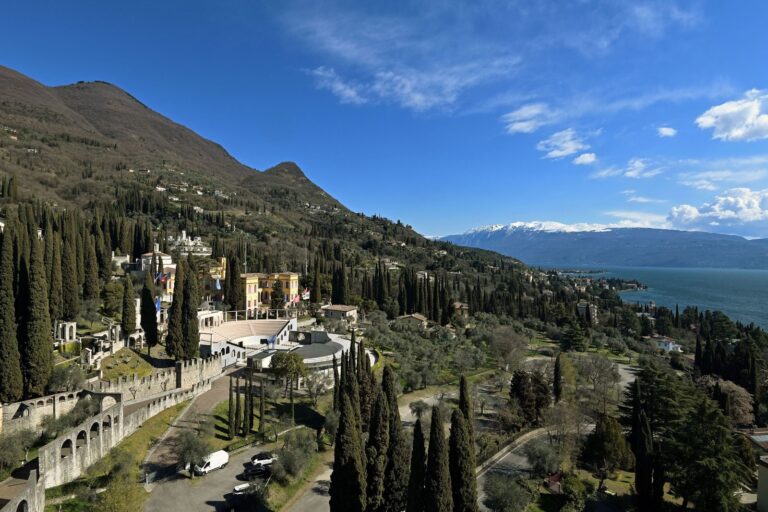
Villa Feltrinelli to Join Relais & Châteaux as Historic Lakeside Retreat
Villa Feltrinelli, the legendary lakeside residence of Benito Mussolini, from where the Duce governed the Italian Social Republic after September 8, 1943, will become part of the Relais & Châteaux chain. The “conversion” is marked by stars and stripes because an American financier, who was previously the owner of the famous Regent Hotel chain, has acquired it.
“It will be a grand house, a luxury home, but above all a place where Mister Burns will welcome his guests who will find nature, serenity, and peace here,” says an impeccable Cristopher Bergen, consultant to the American tycoon who bought the “small castle” built by the Feltrinelli family at the end of the 1800s on the San Faustino estate, north of Gargnano. Three floors dating from 1892, in neo-Gothic Liberty style, covering 2,500 square meters, with a 5-hectare park featuring lemon houses and ancient trees of pine, olive, and magnolia overlooking the lake with a dock.
Renovation Works and Future Development
Regarding the details of the renovation work now nearing completion, Villa Feltrinelli (where Giangiacomo spent many summers of his adolescence) has been postponed until September: “It will be a luxury home,” promises Bergen, “but not an exclusive hotel establishment. Visitors will always be welcome. They will be able to organize meetings for special events here.”
It seems that there is no intention of turning it into a “fortress” for the rich, much to the satisfaction of those – and there are many around Garda – who envisioned a different purpose for the former villa of the Duce: for example, a museum or a contemporary history research center linked to Brescia university or Milano. Already in Gargnano, it hosts the summer headquarters for Lingue, in a building that also once belonged to the family of Milanese publishers.
Restoration Initiatives and Historic Sales
The team of Mister Burns assures that all interventions are purely conservation efforts. The “historic” rooms of the villa, such as the Duce’s canopy bedchamber and the room where Mussolini held the Council of Ministers, will undergo no alterations but only consolidation interventions.
After the renovation, there will be 21 bedrooms available to accommodate up to 40 guests, while the park will be redesigned by a landscape architect. Villa Feltrinelli, which served as the Italo-German political center during 1943-45, was sold in 1981 by Giangiacomo’s heirs, who had been torn apart by an explosive device they themselves were placing on a tower at Segrate.
Subsequently, it was owned by Gargnano Immobiliare srl, a company of Regalini builders from Brescia, until it appeared in the New York Times classified ads in spring 1992: the former Duce’s residence was listed for sale at 5.9 million dollars, about seven billion lire.
Too high a price for a small town like Gargnano, which unsuccessfully appealed to the Ministry of Cultural Heritage to assemble an institutional group of buyers. Now, the fate of this important building, which was the heart of the republican government, is to be transformed into a hotel.