Lake Garda Port Expansion to Address Mooring Demand and Environmental Concerns
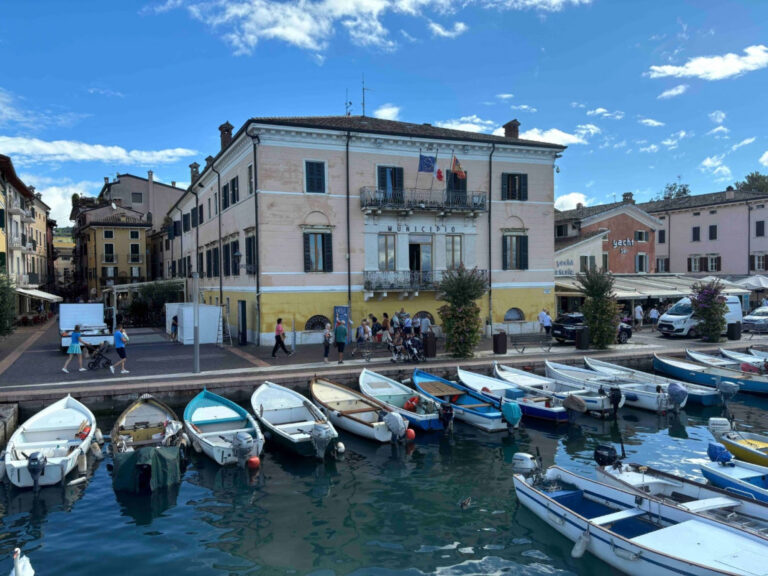
Saturated and unable to meet the ever-increasing demand for mooring spots. The port of the city, one of the largest in terms of capacity on Lake Garda, is the subject of the civil engineering thesis by municipal councilor Lauro Sabaini. The new graduate presented a study at the University of Padova for an expansion project of the current structure, which currently accommodates 122 boats—far from sufficient.
Port Expansion Project
The proposal foresees widening the southern side of the existing port with a main pier and a secondary one. “Despite some variations among different locations, we can generally state that for every mooring request satisfied, there are two or three that cannot be accommodated in the currently existing ports,” writes the twenty-seven-year-old councilor. “Although all municipalities on Lake Garda have at least one port facility, these are insufficient in terms of capacity and lack adequate services.
Originally built within urban centers to house small fishing boats, the ports can no longer meet the numerous requests for mooring and docking from tourists, as urban sprawl has prevented further expansion. Their structures are almost always outdated and of very small size (more than a third of them are under one thousand square meters), making them poorly functional for leisure boats docking.
The arrangement of the piers and the shortage of internal docks limit the number of berths. In fact, about 13,000 linear meters of total dock space accommodate just over three thousand boats—roughly fifty percent of the demand for mooring spots. This leads to the proliferation of mooring buoys of all types along the shores, creating issues not only for swimming and navigation but also impacting the landscape and environment, as most of these are made from plastic tanks or makeshift metal containers.
Economic Resources and Environmental Issues
Recreational boating is an undeniable economic resource. Some surveys, which need proper adaptation for the local context, conducted by an American university indicate that 300 mooring spots, through services and related activities, directly or indirectly generate employment for 1,500 people.
“The time spent ashore by boaters has significantly increased in recent years,” continues Sabaini, “because boats have become smaller, and unlike maritime recreational boating, they rarely allow spending more than a few hours on board. When on land, boaters need bars, shops, restaurants, as well as direct support services for boats, such as refueling with water, electricity, and gasoline.”
It is also known that motorboats produce environmental effects, like pollution, prompting the Province of Trento to impose strict bans on navigation in the upper lake. All these issues are transferred to the other two riviera provinces, which face problems caused by the excessive number of boats and demand, creating an imbalance within the Garda system.
Tourists with motorboats are forced to look for docking elsewhere in other towns, traveling by car and contributing to road congestion.
Conclusions and Proposals
“Therefore, it cannot be denied that recreational boating is now a serious problem for Lake Garda,” concludes Lauro Sabaini, “which must be addressed as soon as possible with solutions capable of balancing the different territorial realities.”
Stefano Joppi