Virtuosi Italiani Perform Water Music on Isola del Garda
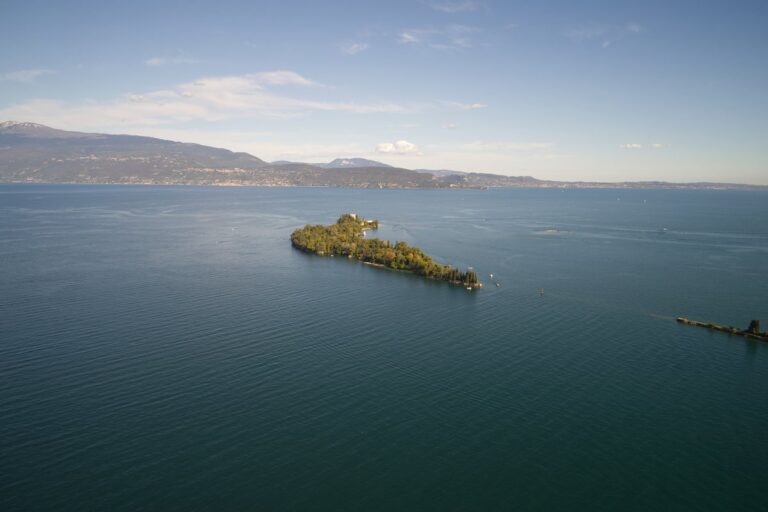
Music on water and fireworks in an extraordinary setting. On Saturday, August 5th, for the Estate musicale del Garda, the Virtuosi Italiani ensemble will perform a concert on Isola del Garda, one of the most enchanting locations in Italy, declared a national monument in 1981 and usually closed to the public.
On this occasion, thanks to the sensitivity of the current owners — the Counts Cavazza — it will be possible to visit the island and admire the Moorish-Venetian architecture of the neo-Gothic villa overlooking a splendid English park and an Italian-style garden.
Event details and musical program
The organizers announced that all tickets have already been sold in recent days. The concert program, selected in accordance with the setting, includes two famous masterpieces by Händel: “Water Music” and “Music for the Royal Fireworks”.
Both scores, which require a large ensemble with numerous wind instruments, were composed in an opulent style to honor the English monarchs. The “Water Music” was performed during a grand party on the Thames attended by King George I himself, along with the London aristocracy.
The other suite was inspired by a peace treaty and was intended to accompany the royal fireworks display. The Virtuosi Italiani ensemble collaborated with internationally renowned soloists and lyrical singers, from Cecilia Gasdia to Katia Ricciarelli, from Giuliano Carmignola to Fabio Biondi.
Recently, in the context of baroque music, they performed Bach’s “Johannespassion” at the Cremona Festival under the direction of Michael Radulescu. The group often tackles a crossover repertoire: notable collaborations include Chick Corea, Goran Bregovic, Michael Nyman, and Franco Battiato.
History of Isola del Garda
Isola del Garda has a long history that dates back to antiquity. The Romans established a colony there, but after the fall of the Empire, it was first taken over by the Goths, then by the Lombards. In 1220, during Barbarossa’s time, Saint Francis of Assisi visited this rocky islet to establish a monastery on its highest point: within two years, the monks planted olive trees, lemons, and vineyards.
In 1817, the island passed to the Counts Lechi, and in 1870, to Duke Gaetano de Ferrari, a wealthy banker, who transformed the island into the romantic garden it is today, entrusting the construction of the new complex at the beginning of the twentieth century to architect Luigi Rovelli.