Marco Franchini Leaves Catullo Airport for Apulia Role
Transfer of Marco Franchini and his role
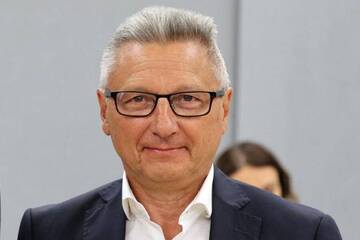
Marco Franchini, director of management and development at D’Annunzio Airport in Montichiari, is leaving the Catullo company (which manages the structures in Brescia and Verona) to lead the airport system of the Apulia region. His appointment became effective as of September 1st, and the Brescia airport loses one of the key figures who made possible the “Brescia miracle” of reopening a runway that until March 1999 was used only by Aeroclub flights.
Franchini joined Catullo Airport in Villafranca in 1988 as an employee, becoming four years later the head of external relations and, after another two, also responsible for general affairs. He worked closely with three presidents of Catullo spa: starting with Virgilio Asileppi, then with Massimo Ferro, and ultimately with the current Fernando Sanson.
In 1988, passengers crossing through Catullo Verona Airport numbered 350,000, and today Catullo and D’Annunzio together handle over 2 million, thanks also to the meticulous work of the Verona-based manager. “I simply built on the results achieved by a large company managed by attentive and forward-looking boards of directors,” explains Franchini modestly. “The secret of success was involving all local communities around the airport without anyone overwhelming the others, ensuring everyone worked together.”
Today, Catullo employs 350 staff members, has a network of 1,200 related businesses, and a significant “social capital”: 40,000 addresses worldwide and 10,000 contacts with tour operators. It also offers high-quality services, recognized by the highest institutional bodies and management authorities of European airports.
The results at D’Annunzio and the success of the routes
Montichiari’s D’Annunzio airport recorded 186,857 passengers in the first eight months of the year, representing a 108% increase compared to the same period last year, when passenger numbers were 89,667. Most, 162,040 passengers, involved international scheduled and charter flights.
Specifically, during this period, 145,836 passengers flew on Ryanair low-cost flights to London, a success well beyond all expectations. Additionally, 35,212 passengers traveled with charters from D’Annunzio, mainly to and from summer destinations in Tunisia and Morocco, and from Belarus, to receive children from families affected by the Chernobyl disaster.
Marco Franchini leaves behind a legacy of trained personnel operating systems characterized by efficiency, speed, and systematic processes. However, his departure will not mean an end to the connections in the Garda airport system.
“It’s not about betraying Verona,” concludes Franchini. “But about exporting our model, our capabilities, and our experience. I would like Puglia to look at the Garda System as a hub for traveling to Europe, so that Puglia can serve as a bridge for Northern Italy towards the Mediterranean basin.”