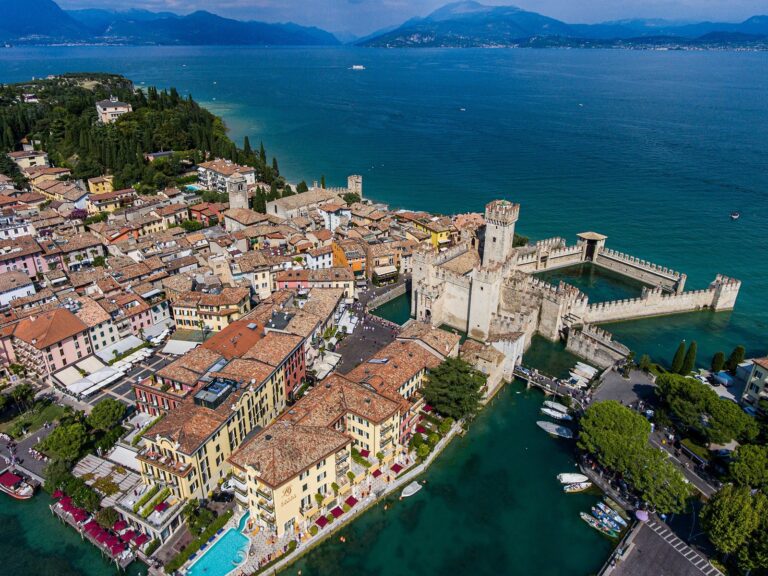
Lake Garda’s History and Traditions Highlighted in New Regional Guide
I wonder if anyone has taken the trouble to count all the travel guides dedicated to Lake Garda that have been published over the years. There are so many that it’s hard to be original. Yet, elements of originality emerge in the latest “historical-artistic guide” focused on the benacense area that has arrived on bookstore shelves.
It was written by Giorgio Vedovelli, president of the Museum of the Scaliger Castle of Torri, already author of numerous volumes dedicated to various aspects of Garda culture.
The edition is interregional: it is authored jointly by Cierre Edizioni from Verona, Grafo from Brescia, and the Trentino association Il Sommolago.
The innovative approach of the guide
What is the innovative approach of Vedovelli’s guide? The answer is: the man. In the sense that the pages of the book vividly reflect the aspects of “Garda-ness” most closely linked to the traditions, customs, and lifestyles of the populations on the opposite shores of Benacus.
Therefore, a sort of mini-encyclopedia of Lake Garda, agile yet rich in content. The structure follows that of traditional travel guides. Yet, each chapter includes that humanistic vision we mentioned.
It begins, of course, with a general description of Lake Garda, but alongside discussions on geology, climate, vegetation, fauna, and history, there’s space for a small section dedicated to “populations and traditions,” almost indicating the path followed in the subsequent descriptive texts of the individual localities of Garda veronese, Trentino Sommolago, and Brescia Garda.
“The benacense populations,” writes Vedovelli, “were historically known for their belligerence”: industrious and sometimes generous people, but with somewhat eccentric minds, as Silvan Cattaneo observed in the sixteenth century.
And even in the mid-1800s, Solitro noted that even the popular festivals were often followed by “fights and bloodshed.” “Aside from some exaggeration, driven by the desire to add a bit of color to the narration,” Vedovelli says, “the most significant human traits of the benacensi were their粗ness and pride, due to the harsh environment in which they lived, especially in the upper lake area, which was a border zone during the time of the Serenissima, and engaged in highly autonomous work such as fishing, shepherding, and farming.”
The centuries-old tradition of fishing guilds further strengthened the independence of the inhabitants, who often included a clause in their statutes excluding zentiluomini—nobles—from their associations, to avoid the risk of being subject to their overbearing influence.
It can be argued that such notes on customs are not common in the typical tourist guides generally on the market.