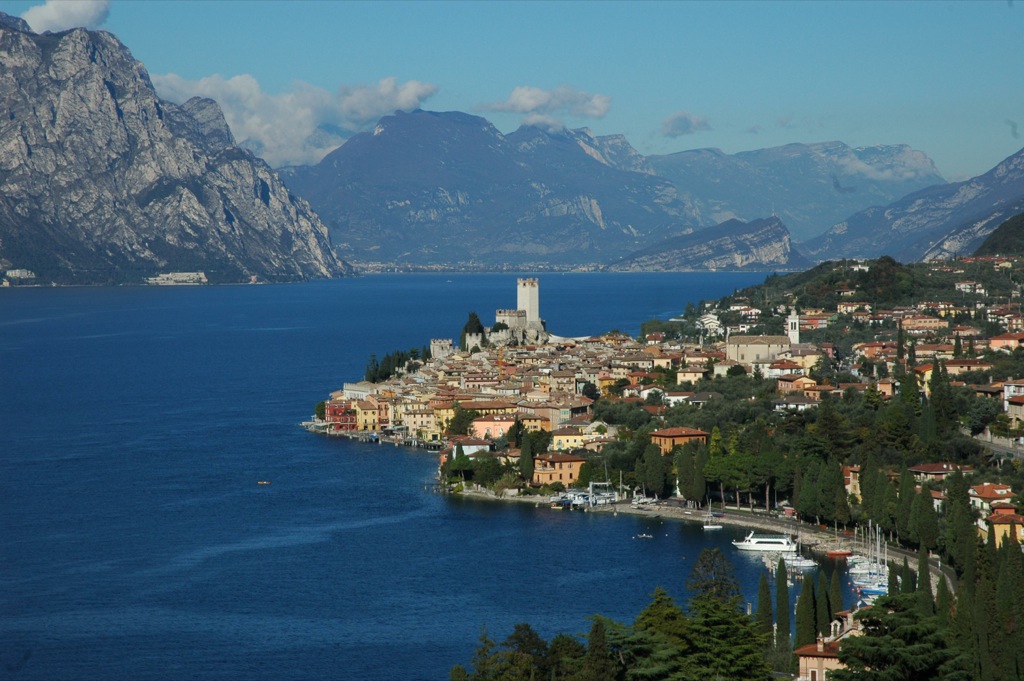
The Malcesine Scaliger Castle stands on a limestone spur overlooking the eastern shore of Lake Garda, guarding the northern waterway and the ancient route between the Veronese plains and Trentino. Declared a national monument in 1902, the fortification, alongside the Scaliger Castle in Sirmione, is one of the best-preserved medieval castle complexes in the entire lake basin.
From Lombard Origins to the Scaliger Signoria
The earliest traces of a fortified garrison on this spur date back to the Lombard era in the late sixth century. The fortress was destroyed by the Franks in 590 and subsequently rebuilt; tradition holds that King Pepin of Italy stayed there in 806. The castle faced Hungarian incursions in the tenth century before falling under the jurisdiction of the bishops of Verona.
Its structural transformation into a formidable watchtower and defense fortress began in 1277 under the Scaliger signoria. Alberto I della Scala initiated the reorganization of the defensive walls, a project continued by Cangrande I and Mastino II to counter the ambitions of the Visconti of Milan and the lords of Mantua. After briefly falling to the Visconti between 1387 and 1403, the castle was incorporated into the Venetian Republic in 1405.
Fortified Architecture and the Keep
The castle ascends in terraces from the village to the summit. The Casermetta, located at the entrance where the castle guard once lodged, now houses the Museum of Natural History of Monte Baldo and Garda. The second courtyard, the Rivellino, dates back to the Austrian period and features a crenellated balcony offering sweeping views of the lake. The highest courtyard contains an ancient well, while the irregular keep rises approximately 70 meters above the water, housing a civic bell from 1442.
Goethe’s Visit and the Espionage Accusation
The castle’s European fame is deeply tied to an episode on September 13, 1786, during the Italian journey of the German poet Johann Wolfgang von Goethe. Forced to dock in Malcesine due to a storm, Goethe sketched the fortress from the courtyard. His actions raised the suspicions of local residents and Venetian guards, who mistook him for a Habsburg spy. After a tense interrogation, Goethe proved his artistic intentions and avoided arrest. This event is documented in the Goethe Room, located in the former Austrian powder magazine.
The Natural History Museum
Today, the Casermetta hosts the Museum of Natural History, redesigned in 2008 with scientific direction from the Civic Museum of Natural History of Verona. Its nine rooms detail the history of the lake, the landscape, and Monte Baldo. The castle also features a fishing museum displaying ancient tools and a traditional flat gondola. The complex is open year-round, with specific opening hours available on the Municipality of Malcesine’s official portal.