The collegiate church popularly known as the Duomo di Salò, dedicated to Santa Maria Annunziata, stands as the most architecturally imposing and artistic sacred monument on Lake Garda. Built during the second half of the fifteenth century over the foundations of an earlier medieval parish church, the building fuses the monumental solemnity of late-Gothic Venetian design with the delicate sculptural refinement of the Lombard Renaissance.
Canonically classified as an arcipretale prepositural collegiate church rather than an episcopal cathedral — Salò belonging to the Diocese of Brescia — the church served for centuries as both the spiritual heart and the civic assembly hall of the Magnifica Patria della Riviera, the autonomous confederation of Garda communities allied with the Republic of Venice.
Fifteenth-Century Architecture on the Model of Sant’Anastasia
Following the reaffirmation of Salò’s loyalty to the Venetian Republic, civic leaders decided to replace the outdated Romanesque pieve with a grand civic church. On 30 April 1452, municipal deputies voted to finance the reconstruction, commissioning master architect Filippo delle Vacche (known as Filippo da Caravaggio), who was later assisted by his son Jacopo.
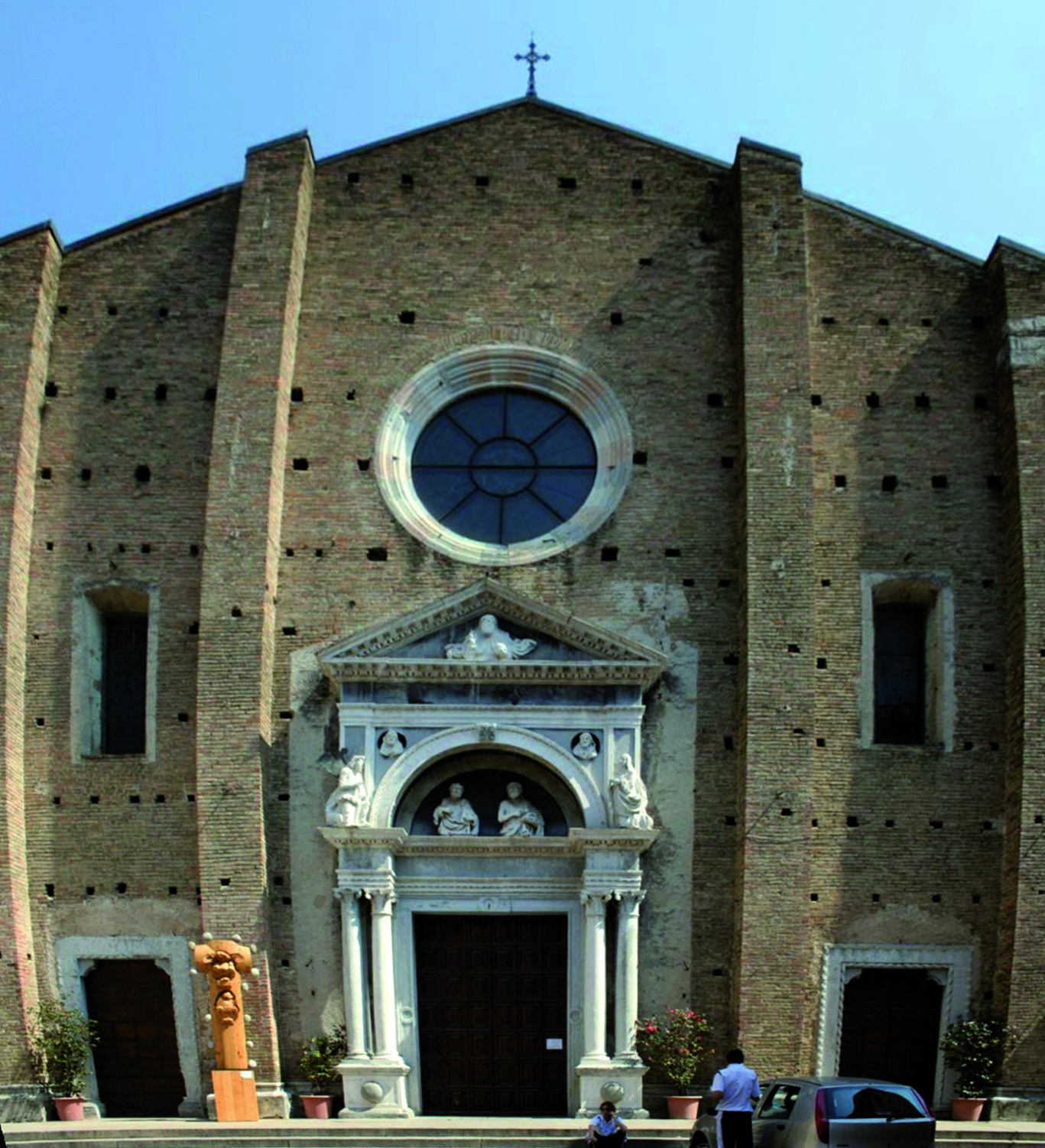
The design closely echoes the celebrated Dominican basilica of Sant’Anastasia in Verona. The exterior presents an unfinished gabled brick façade articulated by slender pilaster strips, a large central circular rose window, and two lateral pointed single-light openings. Inside, the three-aisle basilica layout is divided by two rows of massive cylindrical columns in red and white Verona marble, supporting cross-vaulted bays with terracotta ribs that culminate in a raised transept and deep polygonal apse.
The Renaissance Marble Portal (1506–1509)
The central marble portal represents one of the masterpieces of early Renaissance sculpture in eastern Lombardy. Commissioned in 1506 and executed between 1507 and 1509, the portal is the joint work of Antonio della Porta (known as Tamagnino) and Gasparo Cairano, two of the foremost masters active in the monumental sculptural programs of the Certosa di Pavia and the church of Santa Maria dei Miracoli in Brescia.
Crafted in fine white Botticino marble, the portal features refined classical pilasters carved with delicate candelabra, floral arabesques, and mythological motifs. The upper lunette frames a relief of the Annunciation, flanked by statues of the Virgin Mary and the Archangel Gabriel, establishing a harmonious dialogue between classical antiquity and Christian sacred art.
Sacred Masterpieces: Bussolo Altarpiece, Moerich Crucifix, and Venetian Painting
The interior of the collegiata houses an exceptional treasury of sacred art spanning five centuries. Among the sculptural highlights is the fifteenth-century wooden Crucifix, attributed to northern master Johannes Moerich (Giovanni Teutonico), renowned for its dramatic anatomical realism and expressiveness.
In the Blessed Sacrament chapel stands the magnificent gilded wooden altarpiece (ancona lignea), carved between 1476 and 1483 by master sculptor Pietro Bussolo. The polyptych features ten gilded niches housing expressive polychrome statues of the Virgin and Saints, crowned by architectural spires.
The church walls and side chapels display major canvasses by prominent masters of the Brescian and Venetian Renaissance, including Girolamo Romanino (Saint Anthony of Padua), Alessandro Bonvicino called Il Moretto, and Jacopo Palma il Giovane, whose vast altarpieces illuminate the enduring cultural connection between Salò and the Venetian lagoon.