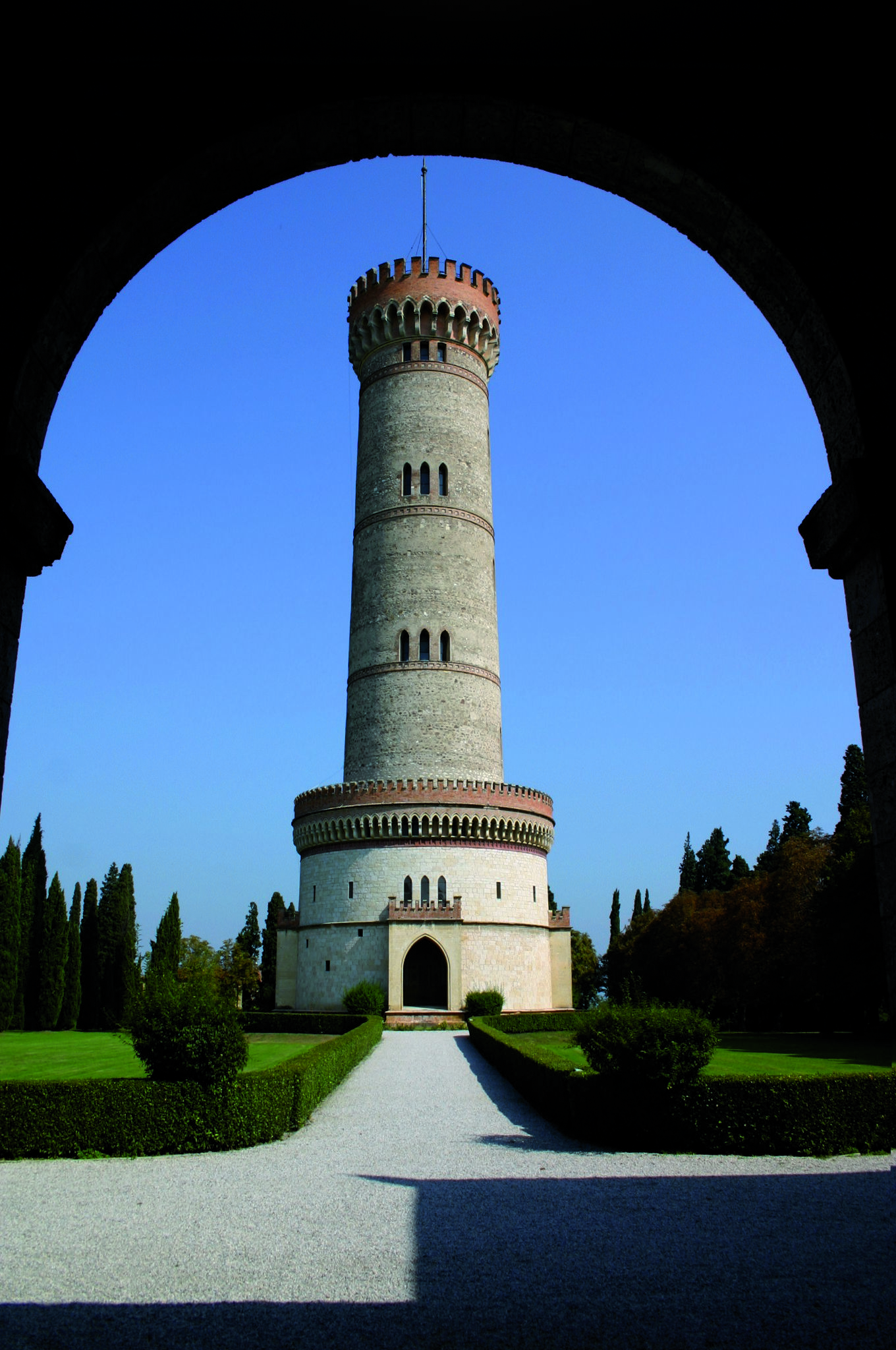
The monumental complex of San Martino della Battaglia, situated on the rolling morainic hills just south of Desenzano del Garda, commemorates one of the decisive clashes of nineteenth-century European history and the birthplace of modern humanitarian law. Dominated by a circular sixty-four-metre stone tower overlooking the southern Lake Garda basin, the historic park encompasses the monumental memorial, the civic ossuary, and the Museum of the Risorgimento, drawing international scholars, military historians, and visitors throughout the year.
Managed since 1870 by the historic Società di Solferino e San Martino, the site preserves the memory of the bloody engagement fought on 24 June 1859 during the Second Italian War of Independence, where Franco-Piedmontese and Austrian forces collided along a fifteen-kilometre front between the lake and the Mantuan plains.
The Battle of 24 June 1859 and Henry Dunant
In the early morning hours of 24 June 1859, the vanguard of the Sardinian bersaglieri encountered imperial Austrian outposts near Cascina Ponticello. Across the ridges of San Martino, the Piedmontese army led directly by King Vittorio Emanuele II engaged in fierce combat against the Austrian VIII Army Corps commanded by Feldzeugmeister Ludwig August von Benedek. The focal point of the fighting was the Colle del Roccolo and the fortified farmstead of Contracania, which changed hands several times in bitter bayonet charges amidst vineyards and drystone walls.
Late in the afternoon, a violent summer storm brought intense wind, hail, and torrential rain across the hills, disorienting the defenders and allowing the Piedmontese infantry to mount a decisive final assault. While Austrian forces retreated toward Verona and the Adige defensive line, the human toll across the entire battlefield — spanning San Martino and Solferino — exceeded forty thousand dead, wounded, and missing soldiers.
The total lack of organized medical relief for the wounded agonising on the field deeply shook Geneva businessman Henry Dunant, who arrived in nearby Castiglione delle Stiviere immediately following the battle. Dunant organized emergency assistance with local townspeople under the rallying cry “Tutti fratelli” (all are brothers). His harrowing account, published in 1862 as Un souvenir de Solferino (A Memory of Solferino), directly catalyzed the establishment of the International Committee of the Red Cross in 1863 and the signing of the First Geneva Convention in 1864.
The Monumental Tower: 64 Metres Above the Morainic Amphitheatre
Following the death of Vittorio Emanuele II in 1878, the Brescia Constitutional Association launched a national public subscription to erect a monumental tower on the Colle del Roccolo. Construction began in 1880 based on architectural plans drafted by Giacomo Frizzoni, with engineering revisions executed by Luigi Monterumici and Antonio Cavalieri. The tower was solemnly inaugurated on 15 October 1893 in the presence of King Umberto I, Queen Margherita, Prime Minister Giovanni Giolitti, and Chamber President Giuseppe Zanardelli.
Built from grey Mazzano stone and structured brickwork, the circular structure rises sixty-four metres above the crest of the hill. At the ground level, the entrance rotunda features an imposing bronze statue of Vittorio Emanuele II, sculpted by Antonio Dal Zotto, flanked by bronze busts of eight generals who fell in the Italian wars of independence.
Visitors ascend to the summit along an interior spiral ramp whose curving wall surfaces are adorned with extensive fresco cycles painted by renowned nineteenth-century masters, including Luigi De Stefani, Vittorio Bressanin, Cesare Vizzotto-Alberti, and Raffaele Pontremoli. The frescoes depict key military campaigns of the Risorgimento from 1848 to the capture of Rome in 1870. The upper open-air crenellated terrace offers a panoramic vantage extending across the Sirmione peninsula, the southern morainic hills, Mount Baldo, and the Po valley.
The Ossuary and the Museum of the Risorgimento
In 1870, Senator Count Luigi Torelli promoted the establishment of the Società di Solferino e San Martino to ensure that thousands of soldiers hastily buried in shallow field trenches received dignified, permanent burial without distinction of nationality. The society adapted the ancient Romanesque church of San Martino — originally recorded in eleventh-century deeds linked to the monastery of Santa Giulia in Brescia — into a consecrated military ossuary.
Consecrated on 24 June 1870, the apsidal sanctuary preserves the skeletal remains of 2,619 fallen soldiers (1,273 Italian and 1,346 Austrian). Reunited in solemn unity, the crypt stands as a profound testament to mutual reconciliation and military honour across European borders.
Adjacent to the tower, the Museum of the Risorgimento displays historical weaponry, artillery pieces, uniforms, field medical equipment, and original cartography from the 1859 campaign, providing visitors with an authentic documentary record of nineteenth-century military life and the birth of unified Italy.