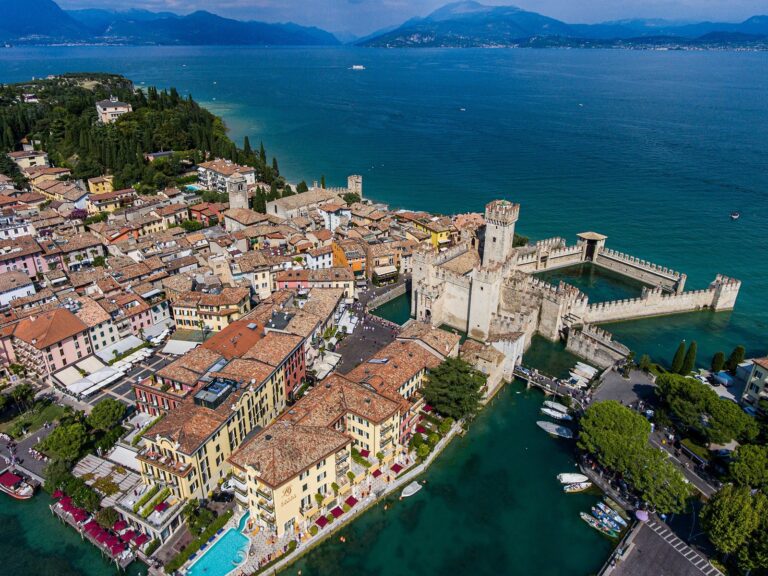
Veronese Lake Tourism Declines, Visitors Stay Longer Despite Overall Drop
In 2000, tourist arrivals on the Veronese side of the lake decreased by 2.5%, dropping from one and a half million to 1,470,000, but there was an increase in the number of days visitors stayed, rising from 8.189 million to 8.708 million (+6.3%).
“Ten out of 19 municipalities,” said Marco Zaninelli, newly appointed commissioner of the Apt of the eastern Riviera, during a press conference held in Garda, “improved both in arrivals and overnight stays. These include Affi, Bardolino, Brenzone, Caprino, Cavaion, Costermano, Ferrara di Monte Baldo, Malcesine, San Zeno di Montagna, and Torri del Benaco. Others—Castelnuovo, Lazise, Peschiera, Valeggio sul Mincio—experienced a decline in arrivals.”
Garda and Bussolengo, on the other hand, report reductions on both fronts. The other areas (Pastrengo, Rivoli, Brentino) have only one hotel; therefore, we cannot provide data due to privacy concerns.”
Trends Among Italian and Foreign Tourists
“Despite the promotional efforts,” continued Zaninelli, “there has been a significant decline in Italian tourists, from 419,000 to 381,000 (-9%), with overnight stays decreasing from two million to 1.875 million (-6.2%). We cannot understand the reason.”
The Veronese lake is especially frequented by tourists from Lombardy, Emilia Romagna, Alto Adige, Valle d’Aosta, Molise, and Campania, while Sardinia, Basilicata, and Trentino have slightly reduced their length of stay. Conversely, other regions tend to skip Garda altogether and choose alternative destinations. Could everyone have gone to Rome for the Jubilee? “Difficult to say,” he responded.
Among foreign visitors, Germans make up the largest group—they are about twice the number of Italians: 13% of total overnight stays (from 3.391 million in 1999 to 3.827 million in 2000), and -3.8% in arrivals (from 700,000 to 673,000).
Many come from Germany following the aroma of Bardolino, regardless of whether it’s red or rosé. They are followed by Dutch (13.3% of overnight stays, increasing from 734,000 to 825,000; 16.6% of arrivals, from 72,000 to 84,000), English (respectively 19% and 28%), Austrians (9.8% and -0.9%), and Danes (7.4% and -4.4%).
The average stay increased from 5.4 to 5.9 days, meaning tourists stay half a day longer. About 40% of tourists choose hotels (which saw a 4.6% increase in overnight stays), while 60% opt for campsites, guesthouses, or other accommodations, which grew by 7.6%.
In this sector, Lazise faces no rivals: it offers 13 camping sites covering a million square meters and featuring seven thousand pitches, plus 800 housing units. Notably, hotel stays increased only slightly (from 4 to 4.2 days), whereas outdoor stays increased more significantly (from 7.4 to 8.2 days).
Impact and Future Outlook of Tourism
“Tourism,” emphasized the Apt commissioner, “has always performed well. The lake remains a sought-after destination, a kind of promised land.” Estimates indicate that on the Veronese side, the sector generates 1,200 billion lire in annual revenue.
Furthermore, measuring the multiplier effect on the economy is difficult. “It’s a reassuring situation,” said Province Councillor Davide Bendinelli, “but I wouldn’t be overly optimistic about the future. Local administrators and entrepreneurs need to change their mindset.”
The former should facilitate and encourage renovations; the latter should reinvest profits. In the 1970s, hotels were built with full occupancy in mind, resulting in rooms of 13-15 square meters and no communal spaces.
Now, customers demand larger spaces and modern amenities: conference rooms, pools, fitness centers. Zaninelli announced that the season will open in April with the Gran Fondo of mountain biking, focusing on Paola Pezzo, and a gastronomic event involving numerous localities.