Mondragone’s Historic Vicaria and the Madonna della Pace Icon
Vicaria of Mondragone, also known as corte and curia, was a small fiefdom, and the person invested with it exercised, in contentious disputes, a limited jurisdiction. This, in summary, is what Don Giovanni Agostini states about the aforementioned vicaria of Mondragone in his book, now very famous, on Lazise.
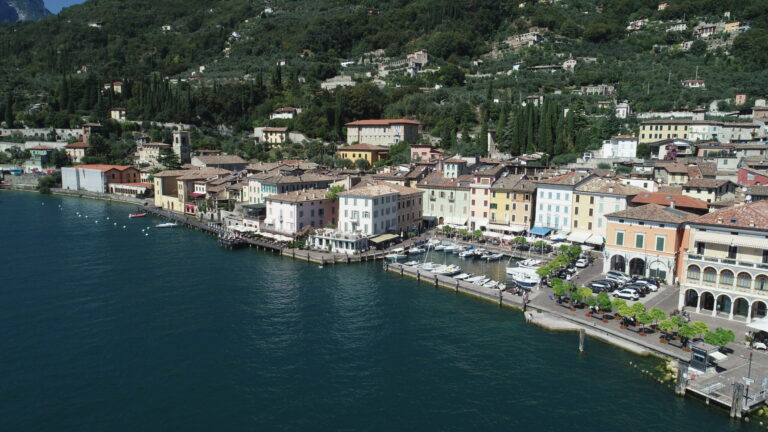
The town of Mondragone today
Even today, Mondragone remains a unique, autonomous locality, separate from the territory of Lazise, but fully part of it.
The location of the Madonna della Pace icon
It is precisely in Mondragone, in the house once owned by one of the town’s notable residents, in the early 20th century, and later owned by the sisters Teresa, Angela, and Santina Olivetti, all unmarried, that, at the behest of Loris Castelletti, the sole heir of the aforementioned sisters, an ancient wooden icon representing the Madonna, called of Peace, was placed.
Blessing and description of the artwork
The wooden triptych, depicting the Madonna with the «dove», was blessed by the parish priest Don Edoardo Sacchella, assisted by Don Nicola Azzali. The piece, of clear Russian style, made of wood, measuring 80 cm by 60 cm, is divided into three sections: the central one featuring the Madonna with Child in her arms, who in turn holds a dove of peace in her hand.
To the right, Saint Benedict with the tablets of the law, and to the left, probably Saint Paul, holding the scroll of the Holy Scriptures, the Gospels. The icon, found in the family home of Castelletti, well crafted and with excellent chromatic coloring, was placed in a specially made niche in the porch of the sisters Olivetti’s residence, known by everyone since the beginning of the century as «le fontane».
The figures involved in the creation and their significance
The work was carried out under the technical direction of Guerrino Zanetti, designer and chief technician, with engraver Giorgio Rizzardi and marble worker Adriano Cristofaletti, and with the artistic-religious direction of Don Edoardo.
«It was commissioned by myself and Guerrino Zanetti», explains Loris Castelletti, «on the occasion of the Jubilee Year, to commemorate the devotion of my late aunts to the Madonna. Zanetti’s contribution», continues Castelletti, «was decisive both for his technical experience and for his knowledge of the place, where he was born and lived from a young age».
The fountains and their historical importance
But let’s return for a moment to the «fountains». Why are they known throughout the area as fountains? The reason is simple. The house they lived in, and which is now a subject of news, was equipped since the 1800s with a fountain spraying pure, high-quality water. This quality is still certified today by the competent health authorities.
Hence, a valuable asset for families, an asset everyone aimed for given the difficult living conditions of those times. The Olivetti sisters always made their fountain, and indeed their fountains and well, available to all families in the vicinity.