
Castle of Desenzano del Garda (BS)
GIORGIO DE CHIRICO: Un mondo senza tempo (A Timeless World)
Curated by Giordano Bruno Guerri
A journey through the art of Giorgio de Chirico and the artists who rewrote the language of 20th-century Italian art
Until October 4, 2026
The exhibition GIORGIO DE CHIRICO. Un mondo senza tempo, curated by Giordano Bruno Guerri and organized by Il Cigno Arte at the Castle of Desenzano del Garda, in collaboration with the Department of Culture of the Municipality of Desenzano, is a second cultural proposal surrounding 20th-century art, presented in a magical place for encounters between art, memory, and territory.
Following the trauma of World War I, artists felt the need to distance themselves from the frenzy of Futurism. Thus emerged the need to seek balance, measure, and the rediscovery of cultural roots, giving birth to the ‘Return to Order’ and ‘Novecento’ (Milan, 1923), while simultaneously Dadaism and Surrealism emerged, offering new interpretations of reality.
In this climate, De Chirico’s proposal succeeded in expressing the ambiguities existing between harmony, classical beauty, reality, mystery, imagination, memory, and returns. De Chirico was elected, unbeknownst to him, as the forefather of Surrealism by its founder, André Breton, who assigned him a fundamental role right from the birth of the artistic movement, whose centenary was celebrated in 2024.
De Chirico became known as an important voice in the journal Valori Plastici, along with a group of artists known as ‘Les Italiens de Paris’: Filippo de Pisis, René Paresce, Alberto Savinio, Gino Severini, and Mario Tozzi, present in the exhibition with one or two works.
The artist’s research proceeded through successive re-emergences, through metaphysical art, and on the themes of Surrealism and the ‘Return to Order’; he indeed maintained: ‘Every object presents two aspects: the common aspect, which is what everyone sees, and the spiritual and metaphysical aspect, which only a few individuals can see… The work of art must evoke this aspect, which does not manifest itself…’
His creativity could not isolate itself in the season of metaphysical painting, which he cultivated on multiple occasions; after the Piazze d’Italia and the Towers, he presents faceless Mannequins (as in The Disquieting Muses), Gladiators, Archaeologists, Mysterious Bathers, and various horses in solitary gallop.
During the years of full metaphysics, the human figure was often erased and/or reduced to a silhouette; in the Piazze d’Italia, he also suspended space and time, with an enigmatic tension entrusted to memory. With the Gladiators (1929), in his reference to the classical world, he undermines the very idea of historical representation. The bodies appear compressed in narrow spaces, within theatrical stage sets, in disquieting constraints where physicality is emphasized yet appears artificial. These are the years in which he brings back bodily weight and volume in the human figure, though non-naturalistic and ambiguous.
Theatricalization and estrangement are evident in ‘Canto nuovo’: a tapestry that provocatively juxtaposes alien memory objects, both common and fantastic, in unusual environments, while light and perspective further distort reality.

In Still Life (1923), everyday objects are isolated; in the subsequent Silent Life (Vita Silente), the contrast prevails between the solidity of the objects and the vagueness of the space, including the castle in the background.
In the 1930s and 1940s, he developed a return to the European pictorial tradition, as in Girl with a Kitten, inspired by an 18th-century French painting which he transforms, just as in Isa, which he renders into a contemporary vision from Post-Impressionism.
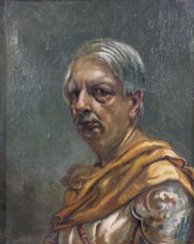
In the Venetian scenes (Venezie), the pictorial surface seems enameled, so compact it is. In the costume self-portraits, such as Self-Portrait with Armor (1947), he represents himself as a historical and simultaneously artificial figure: identity as stagecraft becomes ambiguous. It is in this persistence made of variations and dislocations that his work continues to exert a force of resistance and, at the same time, of attraction.
We arrive at the Sketches on loan from Il Vittoriale degli Italiani: sketches, stage sets, and costumes, rarely visible, produced by De Chirico for the performance of Gabriele d’Annunzio’s La figlia di Iorio, directed by Pirandello, who kept the Vate updated step by step.
For references to ‘Novecento’, promoted by Margherita Sarfatti, the exhibition displays works by Mario Sironi and Achille Funi, among others, along with an interesting exchange of letters between Nino Bertoletti and De Chirico.
Savinio (Giorgio’s younger brother) is also present with his ironic works ‘poltromamma’ and ‘poltrobabbo’, metamorphoses of parents incorporated into their armchairs.
Today, the work of Giorgio de Chirico continues to exert a force of resistance and attraction, thanks to two Nietzschean concepts to which he referred: the eternal return and the Apollonian-Dionysian dualism; by keeping open a zone of ambiguity, he profoundly influenced not only Surrealism, but also Dadaism, Magic Realism, Neue Sachlichkeit (New Objectivity), Pop Art, and Postmodernism.
In the post-WWII era, he remained a fundamental, almost mythical reference for Gino De Dominicis and Mario Schifano, two protagonists of contemporary art who paid him adoring homage and whose works and images are on display.
A stimulating exhibition, not to be missed!
Exhibition Details & Hours: Castle – via Castello 63, Desenzano del Garda (BS). Tuesday-Wednesday-Thursday 9:30-12:30; Friday-Saturday-Sunday and holidays 9:30-18:30. Closed on Mondays. www.comune.desenzano.brescia.it
Read more from GN Magazine – August 2026
-
Wels Catfish Lake Garda Emergency: Contextualizing Environmental Challenges
Explore the Wels Catfish Lake Garda Emergency by Filippo Gavazzoni: containment strategies, native fish protection, and sewage purification priorities.
-
Trans-Siberian Railway: History of the World’s Longest Line
Discover the epic history of the Trans-Siberian Railway, spanning 9,288 km across Russia, built through immense determination, foreign engineering, and sheer human endeavor.
-
Borage Edible Flowers Green Advice: The Green Witch August Guide
Discover Borage Edible Flowers Green Advice by Marina Boschetti: cultivation tips, culinary uses in savory pies, and eco-friendly water recycling.
-
GN Magazine – August 2026
Digital index and English edition of GN Magazine August 2026 (Issue 212). Discover articles on Lake Garda history, culture, and nature.
-
Terme di Sirmione Count Rambaldo di Collalto: Legacy of Spa Excellence
Discover the history of Terme di Sirmione Count Rambaldo di Collalto: 40 years of visionary leadership, Catullo spa foundation, and medical innovation.
-
Emilio Berti and Lake Garda’s Mandolin Tradition: Adriana’s Memories
Discover the story of Emilio Berti (1908-1987) and Lake Garda’s mandolin tradition, preserved through music, family memories, and passion.