
Mantua Palazzo della Ragione – Sonnabend Collection
In the restored halls of the Palazzo della Ragione, the Sonnabend Collection Mantova was inaugurated: an art gallery created by the patron Ileana Sonnabend, fascinated by masterpieces of both American and European art from the second half of the 20th century. The exhibition project was born out of the collaboration between the Municipality of Mantua in partnership with the Sonnabend Foundation and Marsilio Arte, curated by A. Homem and M. Codognato.
The collection, built by Ileana Sonnabend together with her husband Michael Sonnabend and their adopted son Antonio Homem, outlines a map of contemporary creativity, as previously shown in Paris and New York.
From their choices emerge: Figure 8 by Jasper Johns, a multicolored 8 on a bleached background; Little Aloha by Roy Lichtenstein, a seductive iconic face with a flower in jet-black hair, followed by a simplified, magnified spool of thread; followed by Andy Warhol with the equally famous Campbell’s Soup, the one-dollar bill, hibiscus flowers, celebrity series such as Nine Jackies and Ileana Sonnabend, up to installations with boxes of Del Monte or Brillo products.
Kite by Robert Rauschenberg, moving from monochromes to the introduction of color with even jarring tones, followed by silkscreen paintings: photos on canvas over which he superimposes brushstrokes of color.
Further Pop Art artists include James Rosenquist, who paints sliced mortadella (bologna) on a sheet of polyester… Tom Wesselmann, who in Seascape renders a foot sensual; Jim Dine superimposes ropes and trowels on an oil canvas, alongside a metal soap holder across four canvases of four different colors.
We come to the Italian artists: Michelangelo Pistoletto with his mirror painting… the seated man and our reflected image; Mario Schifano in Tempo Moderno, a sheet of paper covered in enamel then glued to the canvas.
Arman assembles famous typewriters as a realistic way to recycle them; Christo wraps a handcart.
We move to Minimalism with Donald Judd: who creates installations such as a plexiglas box that allows light to filter through; while Robert Morris places 9 square-based fiberglass columns, 1.20 m high, side by side.
In sculpture, Bruce Nauman combines neon and language: RAW WAR, to be hung in case of war, flashing in a continuous but separate cycle.
Anselmo, in Hagoromo, also uses neon lettering on wire mesh with beeswax; Jannis Kounellis with Untitled places a sewing machine and a lamp next to a painting: to express contemporary contradictions; Giulio Paolini in Elegy in a Dueling Scene duels with himself, the upper half of the geometrized figures being absent; Gilberto Zorio moves from terracotta to polystyrene, to an unsettling Untitled, to neon stars.
In the space dedicated to photography and performance, Max Becher exhibits, fascinated and dressed as a Native American; Luigi Ontani in Polyptych of Olympus represents himself in 12 Greek deities; Gilbert & George present themselves in a stained-glass window as if at a secular altar; Candida Höfer photographs the Gerolamini Library in Naples, deserted, silent, and filled with light.
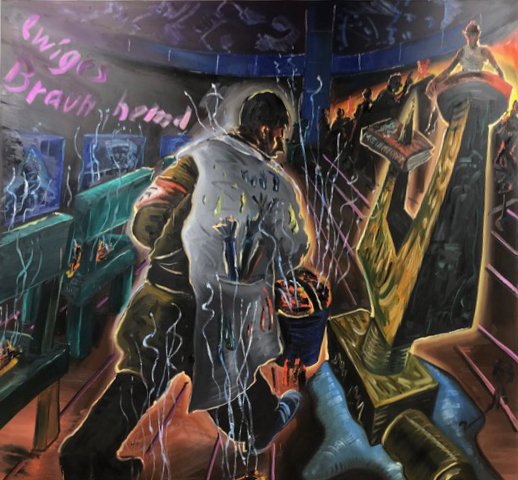
German painting of the 1980s recalls the tragedy of the Shoah, with Jörg Immendorff, with Anselm Kiefer who paints a tree on a lead palette (destruction and renewal), and woodcuts of admirable individuals co-opted by Nazism and distanced by him by covering them with an additional layer of paint; by A. R. Penck, a single work of two compositions: one abstract and one with figures reduced to the essential on a red background pointing to suffering and chaos.
Conversely, contemporary American research proposes with Jeff Koons colorful plastic toy objects inspired by comics and marketing: Wild Boy and Puppy, a plastic dolphin hung on pots, a Greek deity with a blue ball; Haim Steinbach places stacks of red enamel pots, drinks, and matchboxes on shelves he designed himself, as well as various alarm clocks functioning as allegories of wasted time… an ironic seal on this original itinerary, where nuances of complicity were not lacking, as in Warhol’s Screen Tests: short films of various famous characters, viewable until August 23.
Palazzo della Ragione – Hours: Sunday to Monday, 10:00 – 18:00 · Closed on Tuesdays.
Mariateresa Martini – Moniga del Garda, June 22, 2026
Read more from GN Magazine – August 2026
-
Wels Catfish Lake Garda Emergency: Contextualizing Environmental Challenges
Explore the Wels Catfish Lake Garda Emergency by Filippo Gavazzoni: containment strategies, native fish protection, and sewage purification priorities.
-
Trans-Siberian Railway: History of the World’s Longest Line
Discover the epic history of the Trans-Siberian Railway, spanning 9,288 km across Russia, built through immense determination, foreign engineering, and sheer human endeavor.
-
Borage Edible Flowers Green Advice: The Green Witch August Guide
Discover Borage Edible Flowers Green Advice by Marina Boschetti: cultivation tips, culinary uses in savory pies, and eco-friendly water recycling.
-
GN Magazine – August 2026
Digital index and English edition of GN Magazine August 2026 (Issue 212). Discover articles on Lake Garda history, culture, and nature.
-
Terme di Sirmione Count Rambaldo di Collalto: Legacy of Spa Excellence
Discover the history of Terme di Sirmione Count Rambaldo di Collalto: 40 years of visionary leadership, Catullo spa foundation, and medical innovation.
-
Emilio Berti and Lake Garda’s Mandolin Tradition: Adriana’s Memories
Discover the story of Emilio Berti (1908-1987) and Lake Garda’s mandolin tradition, preserved through music, family memories, and passion.