Calling Goethe a “singer-songwriter” is certainly a bold move. But if we think of Italian cantautori such as Franco Battiato, Fabrizio De André, Francesco Guccini and Roberto Vecchioni, to name just a few who wrote true poetry set to music, we may dare to call the German poet par excellence a “poet-songwriter”. The music, of course, is different, because the times were different: Goethe lived between the second half of the eighteenth century and the first half of the nineteenth.
The author of the play Faust, the tragedy Götz von Berlichingen, the drama Egmont, the epistolary novel The Sorrows of Young Werther, the novel Elective Affinities and also the essay The Metamorphosis of Plants, to name the best known of his masterpieces, wrote verse from a very early age. His first poems date back to 1757, when he was only eight.
Over his lifetime (he died at 82) Goethe wrote a great deal, and many of his poems were set to music. One need only think of Beethoven‘s (1770-1827) Six Songs Op. 75 (Sechs Gesänge) for voice and piano, three of which set verses by Goethe, including the well-known Kennst du das Land (Do you know the land). Beethoven also worked on Goethe’s Egmont, writing the overture and several pieces of incidental music.
Franz Schubert (1797-1828) set the Lied Gretchen am Spinnrade (Gretchen at the Spinning Wheel) to a text taken from Goethe’s Faust.
The story of Doctor Faust, ready to sell his soul to the devil to taste earthly pleasures and to be swept into a love affair with young Gretchen, as told in Goethe’s verse drama, also inspired Robert Schumann (1810-1856) to write Scenes from Goethe’s Faust (Szenen aus Goethes Faust), an oratorio composed between 1844 and 1853.
The Hungarian pianist and composer Franz Liszt (1811-1886) had come to know the Faust legend in Goethe’s version in 1830, attending in Weimar La damnation de Faust (1846) by the French composer Hector Berlioz (1803-1869). Captivated, Liszt wrote his Faust Symphony in the 1840s and 1850s, focusing on its three protagonists: Faust, Gretchen and Mephistopheles. The symphony was conducted masterfully by the American conductor Leonard Bernstein (1918-1990) under the title Faust-Symphonie, and first recorded in New York in November 1960.
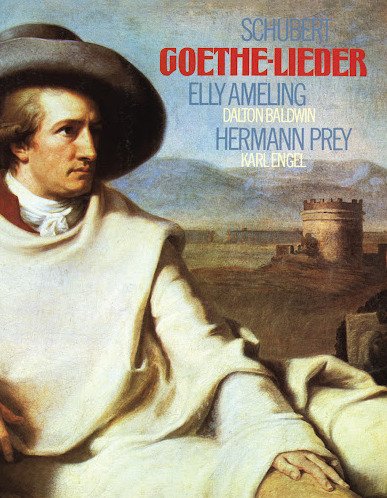
Johannes Brahms (1833-1897), for his part, drew on several of Goethe’s poems for Lieder such as Trost in Tränen (Consolation in Tears), Op. 48 No. 5 for voice and piano.
The Italian librettist and composer Arrigo Boito (1842-1918) also started from Goethe’s Faust to create his opera Mefistofele. Goethe’s poems were the basis for several Lieder by the Austrian composer Hugo Wolf (1860-1903), by the German composer and conductor Richard Strauss (1864-1949), and by the Italian pianist and composer Ferruccio Busoni (1866-1924).
We could go on listing the many other musicians who took inspiration from Goethe’s work, but as a fitting end to this encounter with Goethe, who came to Lake Garda back in 1786, we would rather recall a translation of one of his poems by the poet Diego Valeri, an honorary citizen of Desenzano del Garda from 15 May 1969, a poem that Schubert had already set for voice and piano in 1817.
J. W. Goethe, Gesang der Geister über den Wassern
Song of the Spirits over the Waters
English rendering of Diego Valeri’s Italian translation:
Like the water / is the soul of man. / It comes from heaven, / it rises to heaven, / and down again / it must return to earth, / in endless turn. // The clear stream / gushes from the steep, / sheer cliff; / on the smooth rock / it breaks into lovely / clouds of spray; / it sways, received / into a gentle lap, / among veils and murmurs, / and runs on below. // Rocks rise up / against its rush; / it foams in anger / from step to step / towards the abyss. // Then through a slow bed / of meadows it turns, / and becomes a mirror of lake, / where all the stars / gaze upon their faces. // But the wind / is the wave’s sweet lover; / and at times from the depths / it stirs up foaming billows. / O soul of man, / how like the water you are! / O fate of man, / how like the wind you are!
(Italian translation by Diego Valeri, 1959)
Article by Pia Dusi for GN Magazine (November 2026).
Read more from GN – November 2026
-
Magnifica Patria di Riviera: Six Centuries Since Lake Garda Turned to Venice
A look at the latest cultural events organised by the Municipality of Salò to mark the sixth centenary of the Magnifica Patria’s dedication to the Republic of Venice on 13 May 1426 On 3 October, the Sala dei Provveditori in Salò‘s town hall hosted the most significant of the fifteen or so conferences planned for […]
-
Chrysanthemum: November’s Flower for All Saints
This month I want to talk about a plant you can find everywhere at this time of year, and one tied to a very particular occasion: the chrysanthemum, the flower traditionally brought to our departed loved ones on All Saints’ Day. It is a hardy plant, and it is always in bloom at this point […]
-
Madonna di San Polo: the 2021 Apparition and Bishop Sayaogo’s Testimony
The apparition of 22 May 2021 to three children The story of the Madonna di San Polo in Lonato del Garda continues. Luigi always wished to become known only after his death, and wanted the place itself to become known through what others told about it. That wish was granted on 22 May 2021, when […]
-
Lake Ledro and Lake Garda: the Hidden Link Between Peschiera and Molina
Looking at the two maps that accompany this article, Lake Garda and Lake Ledro seem like two separate worlds, divided by a wall of rock and a drop of some six hundred metres. And yet their waters hide connections that are as unusual as they are fascinating. Lake Ledro is the source of the Ponale […]
-
Ponale Waterfall: Lessons for Tourism on Lake Garda Today
Give yourself a few minutes to read this analysis. It is very relevant to Lake Garda, and it applies just as well to any other area that lives largely on tourism. As is my habit, I will start with a piece of history. It is the late 1920s. The Ponale waterfall, until then roaring and […]
-
Trans-Siberian Railway: the Friulian Workers’ Dilemma at the End of the Line
You see, Luigi, as work on each section of the railway came to an end, with the rails laid and the first test train arriving, all the free workers, that is, those who were not prisoners or otherwise employed by the Russian state, had to decide where to go on with their lives. For most […]